Effect of sub-layer water saturation on two-layer sand fluidization
(1) Upper Merion Area High School
https://doi.org/10.59720/25-314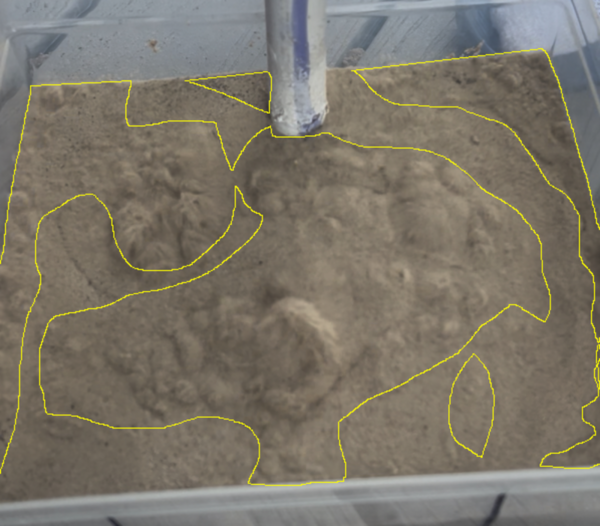
A fluidized bed is a system where solid particles, like sand, are made to behave like a liquid by blowing air upwards through them. Despite being used widely in power plants, manufacturing coatings, and chemical processing since the 19th century, the construction of fluidized beds remains imperfect. Moisture in the granular bed is an unresolved obstacle to efficient fluidization, as previous studies established that moisture significantly hinders the performance of a fluidized bed. Currently, most academic studies and industrial fluidized beds focus on a single layer with homogenous moisture content, and not two different layers. Here, we tested whether injecting air into a dry sand bed placed over a water-saturated sand sub-layer would fluidize the top dry layer. We hypothesized that a layer of wet sand, regardless of water saturation level, underneath dry sand will reduce fluidization efficacy because areas of greater moisture in porous media reduce gas permeability and stabilize the bottom layer of dry sand. Varying the water content of a sand layer underneath a consistently dry upper layer, we used an image analysis software (ImageJ) to estimate the fluidized area and compared those results to uniform fluidization with a two-sample t-test to compare means. The results showed that even 0.5% of saturation hindered the fluidization of the top layer, meaning that a two-layer fluidized bed of any moisture is not viable. These findings underscore the importance of rigorous moisture control in fluidized bed systems, as even minimal, localized moisture can compromise fluidization performance.
This article has been tagged with: