Browse Articles

Antibacterial Effects of Copper Surfaces

Mulukutla et al. | May 19, 2020

Antibacterial Effects of Copper Surfaces

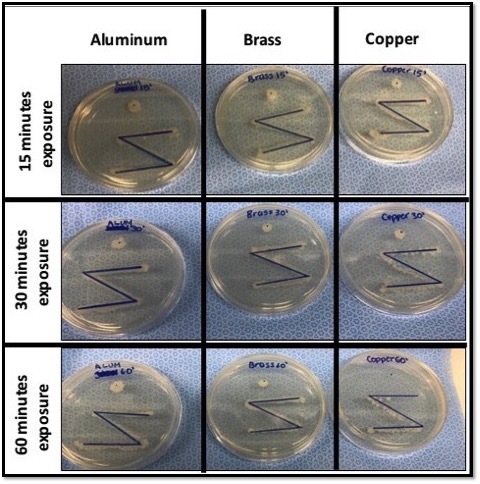
This study examined the ability of copper and copper alloy surfaces to inhibit bacterial growth, which may be help prevent healthcare-associated infections. The authors exposed two non-pathogenic strains of bacteria to different metal plates for varying degrees of time and measured bacterial growth.

Read More...

Investigating the functionality of an Eco-Cooler made of plastic bottles

Tong et al. | Jul 22, 2026

Investigating the functionality of an Eco-Cooler made of plastic bottles
Image credit: Tong, Tong, and Migenes

In the study, the authors looked at an environmentally friendly alternative to A/C systems/cooling. They wanted to test the effectiveness of this cooling system called the Eco-Cooler as well as see if they could improve it. They found that the Eco-Cooler had minimal cooling, while their altered Eco-Cooler system had some cooling. This results shows the use of water helps cool the environment a lot more.

Read More...

A model for angle evolution in conical piles formed using the fixed funnel method

Capaldi et al. | Jul 20, 2026

A model for angle evolution in conical piles formed using the fixed funnel method

When granular materials are poured onto a surface, they form conical piles whose slopes increase before reaching a stable angle of repose. We found that this angle evolution follows a previously unrecognized two-phase exponential growth pattern that is conserved across granular materials with diverse particle properties. The parameters of this model correlate with particle friction and are influenced by deposition conditions, providing a quantitative framework for describing pile formation.

Read More...

Implications of various pure tones on Phaseolus vulgaris and Gaultheria shallon

Judit et al. | Jul 13, 2026

Implications of various pure tones on <i>Phaseolus vulgaris</i> and <i>Gaultheria shallon<i>

This study investigated how different sound frequencies (0, 1,000, 5,000, and 15,000 Hz) affect the growth of Phaseolus vulgaris and the transpiration rates of Gaultheria shallon. Although some differences in plant growth were observed, the authors found no consistent evidence that sound frequency enhanced overall growth or transpiration, highlighting the need for further research.

Read More...