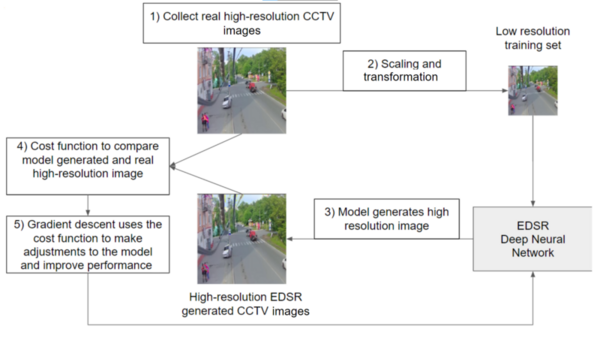
In this study, the authors hypothesized that closed-circuit television images could be stored with improved resolution by using enhanced deep residual (EDSR) networks.
Read More...Deep residual neural networks for increasing the resolution of CCTV images
In this study, the authors hypothesized that closed-circuit television images could be stored with improved resolution by using enhanced deep residual (EDSR) networks.
Read More...Identifying shark species using an AlexNet CNN model
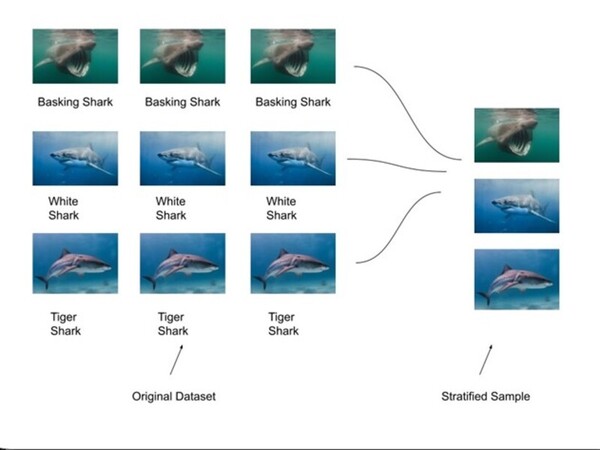
The challenge of accurately identifying shark species is crucial for biodiversity monitoring but is often hindered by time-consuming and labor-intensive manual methods. To address this, SharkNet, a CNN model based on AlexNet, achieved 93% accuracy in classifying shark species using a limited dataset of 1,400 images across 14 species. SharkNet offers a more efficient and reliable solution for marine biologists and conservationists in species identification and environmental monitoring.
Read More...Comparing and evaluating ChatGPT’s performance giving financial advice with Reddit questions and answers

Here, the authors compared financial advice output by chat-GPT to actual Reddit comments from the "r/Financial Planning" subreddit. By assessing the model's response content, length, and advice they found that while artificial intelligence can deliver information, it failed in its delivery, clarity, and decisiveness.
Read More...DNA-SEnet: A convolutional neural network for classifying DNA-asthma associations

In this study, the authors developed a model named DNA Sequence Embedding Network (DNA-SEnet) to classify DNA-asthma associations using their genomic patterns.
Read More...Improving autonomous vehicle perception in adverse weather through image augmentation
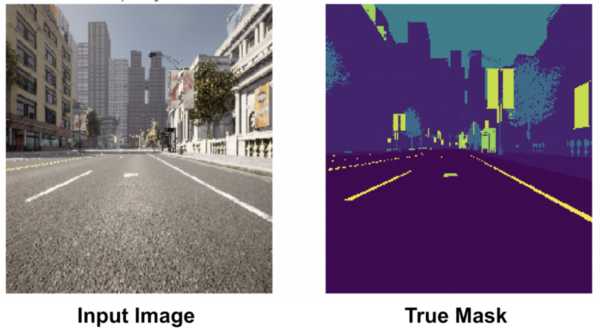
The authors looked at ways that autonomous vehicles could be trained to better perform in adverse weather without the use of actual images taken during adverse weather events. They were able to improve performance, but models using actual images still perform the best.
Read More...Simple solving heuristics improve the accuracy of sudoku difficulty classifiers
Tree-Based Learning Algorithms to Classify ECG with Arrhythmias
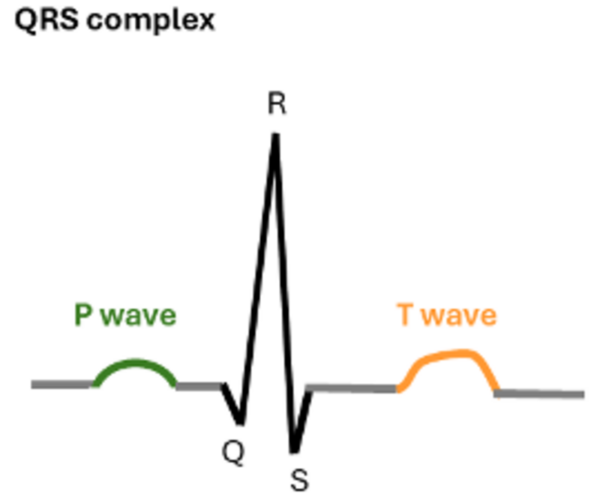
Arrhythmias vary in type and treatment, and ECGs are used to detect them, though human interpretation can be inconsistent. The researchers tested four tree-based algorithms (gradient boosting, random forest, decision tree, and extra trees) on ECG data from over 10,000 patients.
Read More...Training neural networks on text data to model human emotional understanding
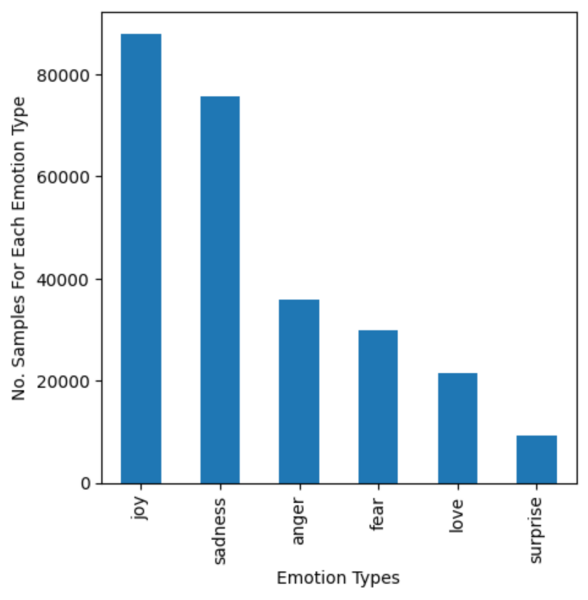
The authors train a neural network to detect text-based emotions including joy, sadness, anger, fear, love, and surprise.
Read More...SmartZoo: A Deep Learning Framework for an IoT Platform in Animal Care
Zoos offer educational and scientific advantages but face high maintenance costs and challenges in animal care due to diverse species' habits. Challenges include tracking animals, detecting illnesses, and creating suitable habitats. We developed a deep learning framework called SmartZoo to address these issues and enable efficient animal monitoring, condition alerts, and data aggregation. We discovered that the data generated by our model is closer to real data than random data, and we were able to demonstrate that the model excels at generating data that resembles real-world data.
Read More...Using two-stage deep learning to assist the visually impaired with currency differentiation

Here, recognizing the difficulty that visually impaired people may have differentiating United States currency, the authors sought to use artificial intelligence (AI) models to identify US currencies. With a one-stage AI they reported a test accuracy of 89%, finding that multi-level deep learning models did not provide any significant advantage over a single-level AI.
Read More...