The development of FeO(OH) nanoparticles to extract synthetic motor oil from freshwater
(1) Council Rock High School North
https://doi.org/10.59720/24-294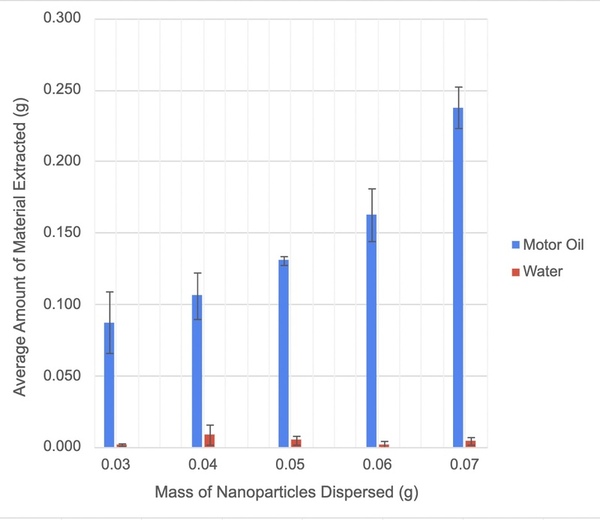
Hydrocarbons, toxic to human and ecosystem health, are a leading contributor to the widespread pollution of freshwater systems. Lower volumes of hydrocarbon pollutants are often neglected by large-scale clean up techniques. To help address this problem, we designed modified iron(III) oxide-hydroxide (FeO(OH)) nanoparticles to extract synthetic motor oil, a model hydrocarbon pollutant, from freshwater. We hypothesized that there would be a positive, linear relationship between the mass of FeO(OH) nanoparticles dispersed and the mass of motor oil extracted. First, we developed the FeO(OH) nanoparticles through the thermal decomposition of FeO(OH) using oleic acid and eicosane, long hydrocarbon modifications that attach to the surface of the FeO(OH) nanoparticles. These modifications allow for the hydrophobic interactions that provide the primary functionality of the FeO(OH) nanoparticles: attracting and extracting the motor oil. We then dispersed increasing amounts of these FeO(OH) nanoparticles into a polluted sample with a low oil-to-water ratio, and later extracted the superparamagnetic FeO(OH) nanoparticles along with oil using a neodymium magnet. We found a significant positive, linear relationship between the FeO(OH) nanoparticle mass used and the motor oil mass extracted with a ratio of 3.57 g of oil removed per gram of nanoparticles. The water mass extracted remained consistently low with water making up, on average, only 3.2% of the total mass of water and oil extracted by the FeO(OH) nanoparticles. These findings provide a favorable solution to combat widespread hydrocarbon residue persistently polluting global water sources.
This article has been tagged with: